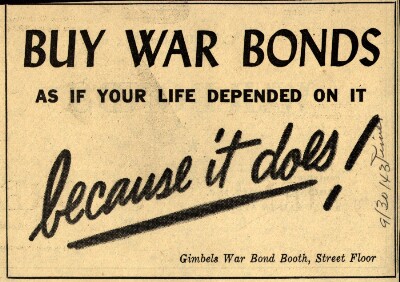
Advertisements, am I right? They clog up TV and our favorite videos on the internet like hair in a drain. They all have one thing in common: to promote something. Sometimes it’s to sell a product while other times, it’s to spread awareness on a sometimes false threat just waiting around the corner. Fear mongering has been a staple in effectively spreading a message despite the damage it causes to a society. But pause for a moment and think about the things that did happen. For example: World War 2. It was a great tragedy and waste of human life, thankfully ending with the U.S. and her allies winning the war. That was all plenty real and America did not win the war without the help of the people. With the threat of the Nazis and Axis powers, the American way of life was in danger as were the American citizen. To win this war, the U.S. army needed funding, rations, and extra material to build weapons and vehicles. Where did this extra funding come from? By the people, of course! And how did the people know to help and how to? As painful as it sounds, from advertisements. In this article, I want to go over how U.S. Propaganda during World War 2 played into, avoid, and addressed fear in the hearts of Americans and explain it to the general audience.
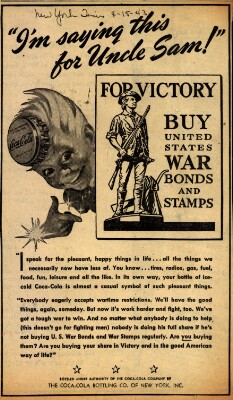
Pictured here is an advertisement for War Bonds, followed by a message explaining the importance of buying them and the eventual return of peace in America.
“I’m saying this for Uncle Sam!”, 1943, Repository Collections and Archives https://repository.duke.edu/dc/adaccess/W0149
The war began in the year 1939 when Adolf Hitler, leader (führer) of Germany, invaded Poland, causing France and Great Britain to declare war. The United States had not joined the war until December 8, 1941 when just the day before, Japan had bombed Pearl Harbor, a direct attack on American soil. It was at that point when the U.S. officially declared war on Japan and in doing so, its allies. With background information explained, it’s time to shift focus on one of the most important aspects of war: resources. Resources come in many different forms from soldiers, food, metal, fuel, and more. As one might know, wars are expensive, both for resources and capital. [1] “The need to raise money to pay for the war by means of war bonds provided one of the most important propaganda themes for posters and the cinema.” In order to raise money for the war effort, war bonds were advertised all over media from cereal boxes to you favorite cartoons. They were a powerful tool and encouraged Americans to buy them in order to support the war effort. In a way, they were like extra taxes one could pay for. But to use them effectively, it had to play with the emotions of Americans. Much of it was patriotism and American pride. Some of it was sadness and empathy for the victims of the war including civilians and soldiers. But a very important emotion used was fear.
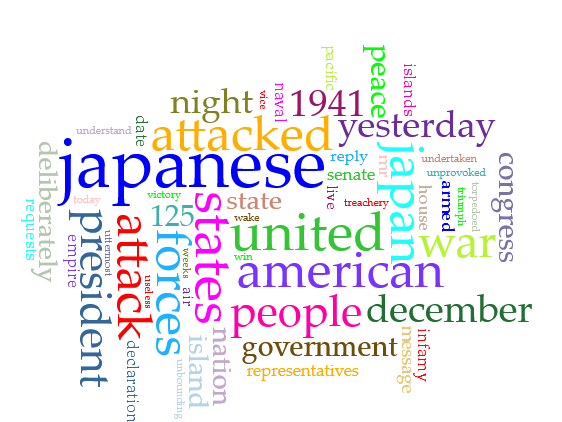
A word cloud based on Franklin D. Roosevelt’s Day of Infamy speech, given on December 8, 1941 formally declaring war on Japan. Created with Voyant.
The usage of fear in propaganda was more than just losing the American way of life or the fear of losing to the enemy. There was ultimately the fear of losing those you love whether in the front lines or at home. America addressed this fear in a multitude of ways from propaganda to famous, influential people such as the singer, Kate Smith. In the book Warfare State: World War II Americans and the Age of Big Government, she recounts a speech from a father of a soldier about what actually buying war bonds is like. [2] “You know, friends, when we buy War Bonds, we’re not buying tanks and guns and shells and planes. What we’re really doing is buying our boys back… bringing them home to us, safe and sound once again.” She concludes her speech by mentioning that the father received a telegram from Washington that morning stating that his boy lost his life in the front. That is perhaps one of the most effective ways fear is addressed in the U.S. during World War 2. Losing a loved one in the fight for freedom is too terrifying to even think about. As sad as it is, it gave the U.S. a significant amount of funding for the war effort through bonds.
Walt Disney, Education for Death, Youtube, 2023.
Walt Disney’s short film, “Education for Death,” took a disturbing, but necessary, approach to the idea of the war. Despite Disney’s warm, family friendly appearance, it was important for the largely influential company to address the villain in quite a frightening way. It showed how a Nazi youth was raised, trained and lobotomized to fight in the war only to die a needless death. Disney took the “fear” approach to inspiring Americans to supporting the war against the Axis powers. Of course, it had a hint of comedy with the Nazi Sleeping Beauty story and the enraged Nazi teacher, but the message was more than clear on how corrupted Hitler, Mussolini, and Hirohito were. In schools, Hitler was treated like an idol; like he was a god. They were taught that only the strongest survive and that the weak must die. They compared people to animals and as such, saw the world in the “predator and prey” vision. When the main character, Hans, was yelled at by the teacher for showing sympathy for the rabbit when it was eaten by the fox, he changed his heart quickly so he may be included among his peers. An important lesson is displayed there as people desire inclusion in their lives. Patriotism was one of the guiding emotions that was used by all countries during the war and it was quite effective for collecting soldiers willing to fight in the war.
Looney Tunes, The Ducktators, YouTube, 2018.
In the cartoon “The Ducktators,” Looney Tunes takes a satirical approach to the threat of the axis powers by portraying them as insane ducks. I believe this was a brilliant way to avoid or belittle the fear of the enemy during the time (note: all stereotypes of countries and cultures portrayed in this cartoon was meant to be humorous during the time. As this is for educational purposes, it is asked that it should be treated as such and not intentionally offend anyone of Japanese, German, or Italian descent. As the “Management” of Looney Tunes stated, “We wish to apologize to the NICE DUCKS and GEESE who may be in the audience.” Thank you). What I found fascinating about this cartoon are the symbols displayed here such as America being stomped on by the enemies. As I recall, this was related to Pearl Harbor and even one of the ducks during the final battle yells “Give them one for Pearl Harbor!” However, I think an important fact they got wrong in the cartoon is that Mussolini was supposedly inspired by Hitler when in reality, it was Mussolini’s dictatorship that inspired Hitler. Much of the cartoons created by Disney or Looney Tunes were never 100% accurate, but did effectively play at the emotions of families during World War 2. This cartoon not only provided a humorous approach to the war, but even advertised war bonds at the end of it. This was one of many cartoons created by Looney Tunes to avoid and/or address the fear of the Axis powers in such a way that they seemed more like bumbling fools rather than powerful dictators.
As Roosevelt stated in his Four Freedoms speech, [3] “the first is freedom of speech and expression – everywhere in the world.” With that freedom, animation companies, food companies, cinemas and the U.S. government itself were able to create propaganda that ranged from a considerable amount of emotions, including fear. In conclusion to this article, I believe fear played a significant role in gaining support for the war effort in America and that America effectively played into, avoided and addressed fear in the hearts of U.S. citizens. Without everyone pitching in on saving resources and purchasing war bonds, the U.S. and the Allied powers would not have succeeded in defeating the Axis powers and preserving the American way of life. Thanks to the usage of fear in propaganda in shows and movies as well as newspapers and posters, the people were moved to help support our brave men in the front lines. Because of this, many of them got to go home to live out their lives, knowing that the sacrifices made by their families and by each other had saved the America and the world from the evils of the Axis powers.
Featured Images:
Coca-Cola Bottling Co., I’m saying this for Uncle Sam!, 1943, New York Times, https://idn.duke.edu/ark:/87924/r4k06xk9r
[1] Welch, David, and David Welch. World War II Propaganda : Analyzing the Art of Persuasion during Wartime. 1st ed. Santa Barbara: ABC-CLIO, 2023. https://doi.org/10.5040/9798216039396.
[2] Kate Smith, Warfare State: World War II Americans and the Age of Big Government (Cary: Oxford University Press, Incorporated, 2011), 119.
[3] Roosevelt, Franklin D. Four Freedoms. National Archives. 1941. https://www.archives.gov/milestone-documents/president-franklin-roosevelts-annual-message-to-congress#transcript
Sparrow, James T.. Warfare State : World War II Americans and the Age of Big Government. Cary: Oxford University Press, Incorporated, 2011. Accessed December 7, 2023. ProQuest Ebook Central.
Roosevelt, Franklin D. Day of Infamy Speech. New York Transcript. 1941. https://www.loc.gov/item/afccal000483/.
How to cite this article:
Joshua Greene, “For Our Boys Up Front: An Analysis on U.S. World War II Propaganda,” Digital History at USC Aiken, 2023, http://digitalhistoryusca.com/?p=1536.


Hi Joshua,
I enjoyed reading your post, and your supporting visuals were great. Propaganda through advertisements certainly played a big part in getting people to enlist and support the war effort. Great Post.
LikeLiked by 1 person
This is a really good topic for a digital article. I enjoyed the variety of primary sources that you were able to include in the actual article, not just link to.
LikeLiked by 1 person