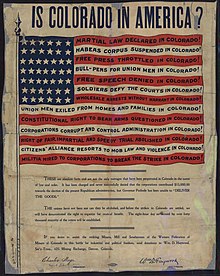
When people imagine the American West, radical armed laborers are not the first thing that comes to mind, yet these individuals played a fundamental role in developing the West and its industries in the early 20th century. With the advent of the Second Industrial Revolution in the late 19th century, many industries began to expand rapidly. This is especially true in the Western United States, with many locally owned farms, ranches, and mines bought up by enterprising corporations in the East. This shift in the dynamics of Western industry caused disillusionment in many. Western expansion was fueled in part by the promise of economic autonomy, with many acquiring land via the Homestead Act. However, many would have to sell their newly acquired lands because of the difficulty of maintaining profitable farms in the West. This left them at the whims of the massive corporations and their absent Eastern owners. By the 1890s, laborers all over the United States would begin to join unions, the most popular being miner’s unions. Miners were especially keen to unionize because of the extremely hazardous conditions of mines and low wages. As the treatment and wages of miners continued to get worse, many began to take up arms against the corporations that employed them, causing unions to become more militaristic. These labor conflicts would permeate into the early 20th century, yet they were mostly contained within the Appalachian mountains of the Eastern United States. This leads to the question, what was different between the efforts of labor organizations in the West versus East? While their efforts to organize and carry out strikes were similar in Eastern and Western mines, Western labor organizations were far more radical in the first years of the 20th century. However, after many brutal losses to mine owners, many Western miners became more conservative.
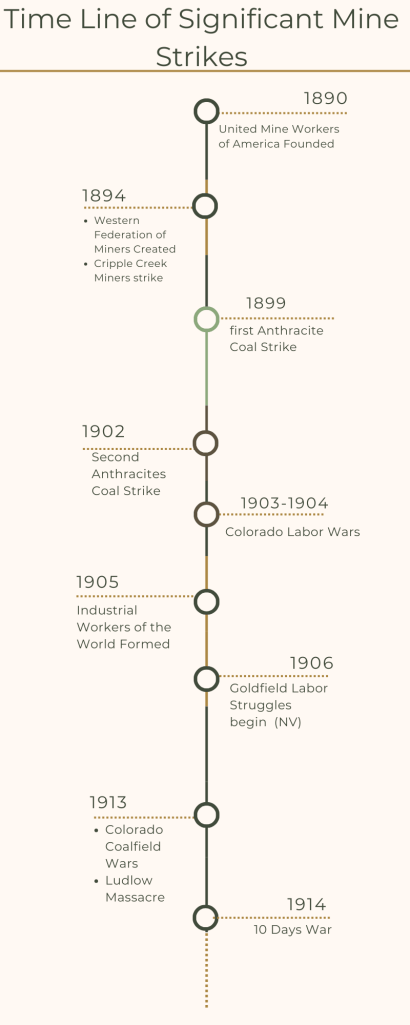
One of the first significant successes of miners’ unions came in 1902, with the Anthracite coal strike organized by the United Mine Workers of America(UMWA), which began the national recognition of labor organizations as a tool for miners. In the years preceding 1902, miners made many attempts to strike for an 8-hour work day, higher wages, and recognition of unions. These attempts were unsuccessful until 1900 when the UMWA attempted to act as the bargaining agent for the miners as they had for strikers in Illinois, Ohio, and Indiana. However, the coal operators never recognized the union, and it was an election year, so the union was forced to settle on only a 10% wage increase due to mounting political pressure. This led to another strike in May of 1902, which was much more successful. Initially, coal operators again refused to recognize the UMWA, which led to a 5-month strike. Due to the approaching winter and possible national coal shortages, President Theodore Roosevelt invited John Micheal, president of the UMWA, and coal operators to the White House on October 2 to personally arbitrate the dispute.1 This became known as the Coal Conference of 1902, yet the operators still refused to recognize the Union. Seeing no other solution, Roosevelt threatened to send the army to operate anthracite mines to avoid a shortage, which neither the coal operators or miners wanted. This resulted in another wage increase and a reduction in working hours, but the operators still never recognized the union.2 Despite never being recognized by the coal operators, the result was still an important victory for labor organizations as well as miners. Being recognized by the president validated the union and increased membership. Additionally, the UMWA’s use of peaceful federal intervention set them apart from more radical and violent unions, like the Western Federation of Miners.
The peaceful resolution of the strike at Anthracite contrasts with the work of the Western Federation of Miners(WFM), another popular miners’ union created in 1894. However, their methods were far more radical, which resonated with many in the West. Miners from Colorado founded the WFM; between 1865 and 1912 the fatality rate of Colorado miners was doubled the national average. The union’s first notable activities took place in Cripple Creek, Colorado, in 1894 and ended in a violent conflict. The violence Cripple Creek began when striking miners attacked strikebreakers and sheriff’s deputies. This conflict continuously escalated, resulting in the Colorado state militia fighting an army of deputies funded by mine operators. This conflict ended in a union victory, which further radicalized the WFM and Western miners.
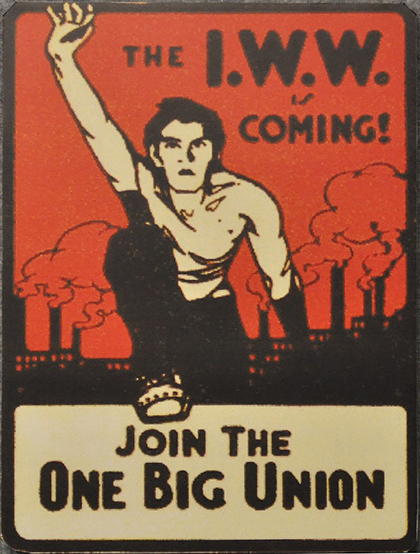
In 1905, the Industrial Workers of the World(IWW) was formed in Chicago in an attempt to create “one big union,” with the WFM joining the incredibly radical union as its mining department. The IWW was extremely radical, with prominent Marxists such as Mary Harris Jones and William Heywood being at the organization’s head; however, they worked with the comparatively conservative WFM throughout the West until the Goldfield labor struggles of 1906. Goldfield was a newly formed mining town in Nevada, and as production grew, miners quickly joined the WFM. The IWW was incredibly powerful in Goldfield, with IWW leader Vincent St. John stating: “The highest point of efficiency for any labor organization was reached by the I.W.W. and W.F.M. in Goldfield, Nevada. No committees were ever sent to any employers. The unions adopted wage scales and regulated hours. The secretary posted the same on a bulletin board outside of the union hall, and it was the LAW.”7 Mine owners wanted to maximize the production of gold no matter the cost, which meant the union did not have to negotiate; they could post wages and working hours, and mine operators were forced to comply. This reinforced the conceptual goal of the IWW, which could’ve reignited the radical origins of the WFM. However, national WFM workers, mine operators, and business owners did not like the radical socialist and Marxist ideology of the IWW. So when miners began to strike in 1907, over receiving cash wages rather than gold, the governor of Nevada urged Theodore Roosevelt to send in federal troops to maintain order and stop potential IWW violence. Yet, when federal troops arrived, they found the striking workers were peaceful. A day after their arrival, mine operators announced that the mines would reopen within the next few days with lower wages for miners and that no IWW miners would be rehired, making it clear that these were the mine operators’ plans all along and ending the labor struggles. This was a crushing defeat for IWW and caused the WFM to split from the union, which marked a more conservative turn for the WFM and miners in the West as a whole.
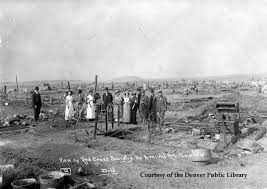
The nail in the coffin for massive strikes organized by unions was the Colorado Coalfield War in 1913. The Coalfield War began with strikes in many different industries in Colorado in response to the Colorado Fuel and Iron Company, owned by John D. Rockefeller, and its awful treatment of laborers. The years before the conflict had a spike in mine explosions, which only raised the incredibly high mortality rate from 6.3 to 10 per 1000 workers.8 Strikes began in southern Colorado, with workers demanding the enforcement of the Mine Safety Act passed in 1913. The strike peaked at about 20,000, with every worker and his family being evicted from company housing. The UMWA supplied tents to each family, setting up tent colonies throughout the state. Tensions steadily rose, with small numbers on each side being killed in small conflicts. By 1914, strikes were relatively peaceful until April 20th, when Colorado national guards invited the leader of the Ludlow colony to speak. When he did not acquiesce, the standoff turned into a firefight including over 100 laborers and national guards and resulted in a fire that burned down the colony. After the fighting ended, all of the laborers involved in the fighting were found shot in the back, along with eleven children and two women who were suffocated by smoke. This sparked the Ten Days War, which involved 2 engagements between strikers and anti-union forces, resulting in the deaths of 54. On May 2nd, laborers were told to disarm before federal troops flooded colonies. The secretary of labor arbitrated a negotiation that would cease hostility and for CF&I comply with the Mine Safety Act. However, they would continuously refuse until UMWA ran out of money, ending the strike. This total loss destroyed any hope from miners that their working conditions would improve, ending large-scale mine strikes and lowering support for unions. The next large-scale strikes and conflicts would happen years later in Virginia because eastern miners had not yet endured decades of losses to corporations.
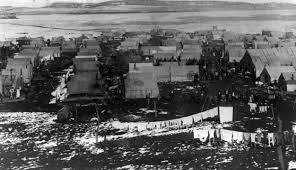
The Ludlow Colony before and after April 20th, 1914 (https://www.du.edu/ludlow/gallery1.html)
In conclusion, Western miners were far more radicalized at the turn of the 20th century, with Western labor organizations reflecting this sentiment. However, as organizations continuously lost conflicts in the West, they were eventually demoralized and became far more conservative. This contrasts the position of Eastern miners, who were comparatively peaceful and less radical, yet they still found little success. The Anthracite Strike in 1902, organized by the NMWA, best exemplifies this. Theodore Roosevelt peacefully arbitrated an equitable solution between miners and mine operators, giving Eastern labor organizations more credibility and a more peaceful methodology. This can be contrasted with labor disputes organized by the WFM. Starting in 1865, the fatality rate among Colorado miners was double the national average. This led to Colorado miners and the WFM being far more radical than contemporary Eastern labor organizations. Their radical methods led to a successful strike in 1894. However, the Labor Wars in 1903 were a decisive loss, leading to the expulsion of hundreds of union miners and marking a conservative shift in the WFM. As the Marxist IWW found tremendous success in Goldfield, Nevada, radical sentiment among Western miners was strengthened until a plot by mine owners eventually forced the union out. The final nail in the coffin was the UMWA’s devastating loss in the Colorado Coalfield Wars. The armed conflict resulted in the countless deaths of striking miners and their families. The absolute failure of the union and even government intervention caused many miners to give up their hopes of bettering the conditions of Western mines.
Endnotes
1. United States. Anthracite Coal Strike Commission, Report to the President on the Anthracite Coal Strike of May-October, 1902, (1903).
2. Perry K. Blatz, Democratic Miners: Work and Labor Relations in the Anthracite Coal Industry, 1875-1925 (SUNY Press, 1994).
3. Vernon H. Jensen and George G. Suggs, “Colorado’s War on Militant Unionism-James H. Peabody and the Western Federation of Miners.,” ILR Review 27, no. 3 (April 1, 1974): 472, https://doi.org/10.2307/2521634.
4. Louis Freeland Post, The Public (November 5, 1904). 487.
5. Harry Orchard, The Confessions and Autobiography of Harry Orchard: Assassin and Terrorist for the Western Federation of Miners (1907). 375-379.
6. United States. Bureau Of Labor and Carroll Davidson Wright, A Report on Labor Disturbances in the State of Colorado from 1880 to 1904, Inclusive: With Correspondence Relating Thereto, (1905.)
7. Vincent St John, The I.W.W.: Its History, Structure, and Methods (IWW PUBLISHING BUREAU, 1917).
8. Thomas G. Andrews, Killing for Coal (Harvard University Press, 2010).
Featured image: https://digital.denverlibrary.org/digital/collection/p15330coll22/id/84101/
How To Cite:
Wyatt Spivey, “Radicalism, Mining, and The American West In the Early 20th Century,” Digital History at USC Aiken, 2023, https://digitalhistoryusca.com/2023/12/08/radicalism-mining-and-the-american-west-in-the-early-20th-century/(opens in a new tab).


Hey Wyatt. I think you did an excellent job explaining these strikes. It’s very unfortunate that the many miners over the years had to unionize due to the unfair conditions. I feel like mining altogether is not a safe job if we often hear about strikes in the profession.
LikeLiked by 1 person