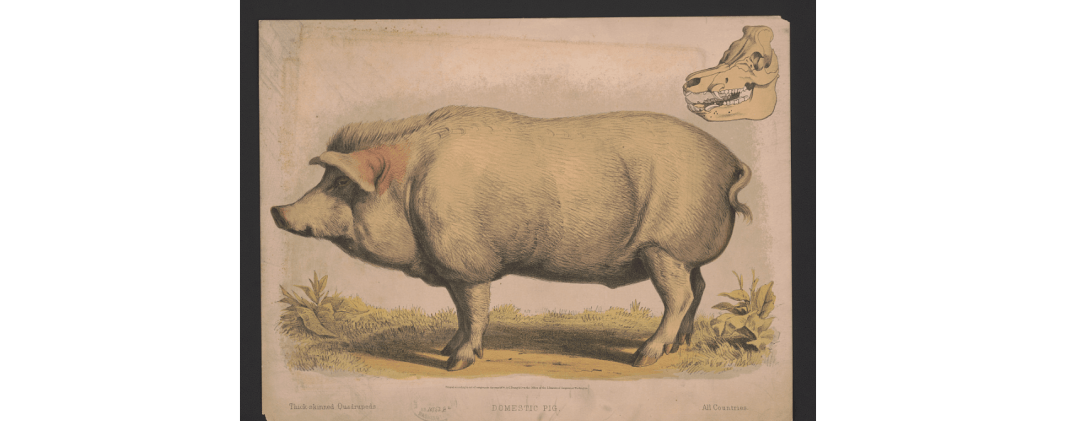
Picture this, you wake up one brisk fall morning and as you stroll into the kitchen, the bubbling sound of grease popping and the savory aroma of bacon frying on a cast iron skillet graces your nose. What you are experiencing are the same things James Oglethorpe, George Washington, or any other resident of the British American colonies and the early United States did in the seventeenth and eighteenth century. This article seeks to be an academic, yet easy to understand investigation into the vital role of the humble pig. More specifically, why the swine’s adaptiveness, ease of husbandry, and usefulness made it the single most crucial piece of livestock in Early American History.
Now, it should be noted that Sus scrofa domesticus’ – the domestic pig’s – widely accepted status and heightened role in the American colonies is not reflective of the species’ overall history. Instead, the animal has been subjected to a seemingly ever-fluctuating condition, where it has gone from the bottom to the top of the social status pole. Notable examples of lows being in the Abrahamic faiths of Islam – “He has only forbidden to you dead animals, blood, the flesh of swine, and that which has been dedicated to other than Allah.” and Judaism – “and the swine, though he divide the hoof, and be clovenfooted, yet he cheweth not the cud; he is unclean to you.” Here the animal was widely regarded as dirty, thus not religiously fit for consumption. Contrastingly, the pig soared to new heights in Rome where it demanded the highest price of any meat, possessed more descriptive names than any other animal – “suarii” (live pigs), “porcinarius” (fresh pork), and “pernarius” (ham) to name a few – and was the favorite food of many emperors.[1] By the age of European Colonization, however, the pig had retreated to a more middling role. Mark Essig explains in his book, Lesser Beasts: A Snout-to-Tail History of the Humble Pig, that pigs were commonplace and held a degree of value in society, mostly for waste disposal, but those of higher prestige strayed away from the animal’s flesh. Gervase Markham’s 1614 book Cheap and Good Husbandry explains that the swine was “the husbandman’s best scavenger, and the huswive’s most wholesome sink,” implying that these animals were most useful as a garbage disposal. So, pigs were not ungodly as they had been in Biblical times but were certainly far-off from their once imperial status. This subservient role was soon to change, though, as the New World signaled promise for not just humans, but also pigs.
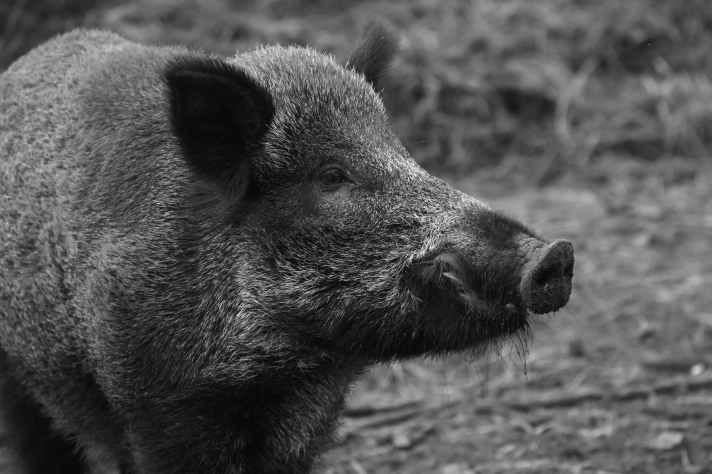
Black Boar, November 3, 2016, Pixabay. https://pexels.com/photo/animal-black-and-white-pig-wild-animal-236684/.
Hogs are extraordinarily adaptable, evident from their residency on the tropical islands of the Caribbean to the snowy forest of Northern Europe. While many things in the animal’s biology aid this, most notable among them are its extreme intelligence, variance in diet, and ability to go from a life of domesticity to feral seemingly overnight. For centuries, carnies – those specializing in cheap traveling attractions – have used the pig’s ability to spell basic words or other minor tasks as a means to make money, displaying its mental abilities, ones that are equivalent to a two-year-old child.[2] Regarding diet, the Internet Center for Wildlife Damage and Management writes that while 85% of the swine’s diet is comprised of vegetation, when conditions become unfavorable for plant life they increase their feeding range and their carnivorous habits. The University of California Agriculture and Natural Resources’ Statewide Integrated Pest Management Program (UC IPM) seconds this, adding that pigs have a voracious appetite. They have been known to consume other livestock’s young and even mature sheep. And concerning the animal’s ability to turn feral rapidly, Boss Tools, a company specializing in animal husbandry, states that only a few months are needed for a domestic pig to turn feral, decreasing its reliance on humans. It should come as no surprise then why the Spanish and later English understood that pigs, because of their adaptability, were going to be crucial to their endeavors in the New World.
Columbus, upon returning from his 1492 voyage, began making immediate plans for a return trip. What he loaded onto his ship was everything he would need to replicate the complex Spanish diet: fruits, vegetables, cows, sheep, and an outlier, pigs. While not the pinnacle of Spanish cuisine, Columbus and his crew knew that the aforementioned qualities of the pig meant they could leave them on islands they ventured to. These could then be used to feed further expeditionary groups for centuries, so long as they left one breeding pair as instructed.[3]
The English took this one step further in their continental American colonies. Essig writes that while the British Isles and their Caribbean Colonies were labor rich and land poor, the opposite was true for on the mainland. Colonial farmers, in order to remain profitable, were forced to farm large swaths of land, reducing time for animal husbandry. Labor intensive animals like cows and sheep, with their slow reproduction habits and limited diets would take decades to develop a profitable and sustainable production. They knew, though, that hogs’ adaptiveness meant they could allow them to freely roam about the woods, feeding upon the multitudes of wild fruits and nuts.[4] These animals could then be herded and driven into market when selling time came or they could be hunted like deer. A 1777 report from the Journal of Nicholas Creswell says “When there is a plentiful Mast (what they call Mast are acorns, Walnuts, Chestnuts, and all wild fruits) the Hogs will get fat in the woods with little, or no corn. Great quantities are killed as soon as they are taken out of the woods, salted, barrelled and sent to the West Indies. Sells from 12 to 27 shillings Currency per hundred.” Europeans who visited the Colonies were shocked to find a seemingly new breed of hog, one that was slender at the leg and short in the body.[5] And they noted that the animal roamed free, in the thousands, showing just how quickly land keepers took to the four-legged friend. The pig’s inclination to adaptation was not the only thing aiding its newfound success in the Colonies, though.
Somewhat related to adaptation but differing enough to deserve its own explanation, pigs excelled in the New World because of the relative ease of husbandry associated with them. The UC IPM explains that pigs have a similar digestive tract to humans, meaning that they can consume a similar diet. Denoting, they can eat just about anything. Now, settling new land is understandably difficult, so why not take advantage of an animal that eases that process ever so. This is exactly what colonizing farmers did. A planter from Georgia exclaimed just how easy hog farming was. “They who begin only with a sow or two, in a few years are masters of fourscore, or a hundred head.”[6] Mount Vernon, George Washington’s estate, adds to this argument, explaining the first president allowed his pigs to roam freely about and reproduce. The only time they would handle the animal is when it was time for slaughtering. This caused the swine to become a favorite among colonizers, with them often owning many more pigs than other animals. Seen in a 1725 last will by James Bray, a resident of Williamsburg, VA, he owned sixty-four pigs. A feat that would have been difficult to achieve had the animal been penned. Hogs provided the best of both worlds for these people. They could take a relatively hands off approach, yet still reap all of the rewards. Sure, they destroyed the natural environment and displaced Native Americans and indigenous wildlife, but that was hardly a concern for Europeans facing the seemingly never-ending bountifulness of America.
The final ability of the pig that solidified its place at the top colonial livestock value, was its versatility and usefulness. Considering the role of swine, food undoubtably crowns today’s list and this is also true for the 1600s and 1700s. In fact, it was the most common meat in the colonies.[7] The above-mentioned qualities meant it was a readily available and cheap source of protein. Hannah Glasse’s 1747 cookbook The Art of Cookery Made Plain and Easy, self-described as “America’s Most Popular Cookbook in 1776,”supports the prevalence of the pig. She prefaces her work by giving brief explanations on how to cook various types of meat. For venison, beef, and others she devotes approximately a paragraph each. Pigs, on the other hand, warrant three pages.[8] And some of the earliest military rations included salt pork. Pigs equated to being food for all in the Americas, not just rich or poor.
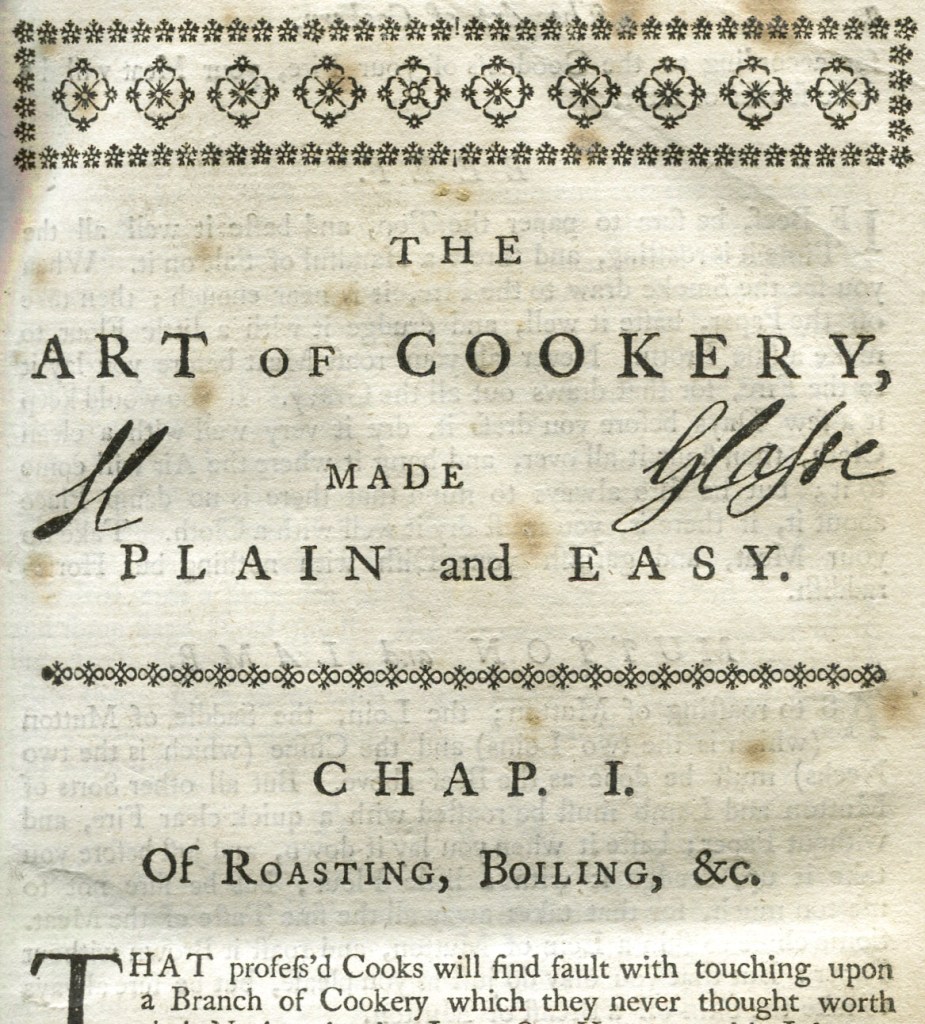
Glasse Art of Cookery 1758, 1758. https://commons.wikimedia.org/wiki/File:Glasse_Art_of_Cookery_1758_Signature.jpg
Unlike today, the pig’s usefulness far exceeded merely food. Instead, it could be used for waste disposal as Markham referenced, land clearing, and even leather. By allowing the animals to move about the countryside, new growth in the American forest were rooted up and eaten, subsequently being destroyed. Mark Essig also touches on this, explaining that as the pig moved westward, so did Europeans. New fields were cleared first by snout and later by plow. He goes on, Miantonomi, a Narragansant sachem, explains that his people – Native Americans – were driven from their lands in part by pigs.[9] Finally, pigs could be used as a substitute for necessities like leather. With cattle being hard-pressed in the colonies and pigs being abundant, pig leather was a natural side effect. In 1776, Patrick Henry received a letter from Gabriel Maupin stating that Henry was to acquire a hog skin saddle. In short, the pig traversed many of the hurdles the New World brought about, including food, land, and goods.
In many ways, the pig is a perfect analogy for the first colonial Americans. The colonies were a hardnosed place, it forced people to be resourceful and adaptive, much like the humble swine. While the pig may have not been the most prized piece of livestock in early American history, it is undebatable that it was the most vital. Through the pig’s adaptability, ease of husbandry, and utility, it secured itself a spot in this argument.
Thought Provoking Questions:
- If explorations to the New World had occurred several centuries before, when Europeans’ had a different relationship with the pig (loved or hated it more), would it have altered their dependance on pigs?
- Had pigs not been introduced during the 1600s, would the America’s display such a dependence on them today?
- With the complexities of the pig’s case, should this be regarded as a story of success as Americans thrived on the animal or as a tale of defeat as Native Americans were displaced and their land destroyed by the animal?
Featured Image:
L. Prang & co., Domestic Pig, 1874, Library of Congress, https://www.loc.gov/item/2017660728/.
[1]Essig, Mark. “Monstrosities of Luxury,” Lesser Beasts: A Snout-to-Tail History of the Humble Pig. (New York: Basic Books, 2015). 68-69.
[2]Essig. “Prologue: The Magical Animal,” Lesser Beasts. (Basic Books, 2015). 5-6.
[3]Essig. “All the Mountains Swarmed with Them,” Lesser Beasts. (Basic Books, 2015). 119
[4]Essig. “A Great Unkindness for Our Swine,” Lesser Beasts. (Basic Books, 2015). 135-136
[5]Essig. “A Great Unkindness for Our Swine,” Lesser Beasts. (Basic Books, 2015). 137.
[6]Essig. “A Great Unkindness for Our Swine,” Lesser Beasts. (Basic Books, 2015). 139.
[7]Essig. “A Great Unkindness for Our Swine,” Lesser Beasts. (Basic Books, 2015). 137.
[8]Glasse, Hannah. The Art of Cookery Made Plain and Easy. (Bedford: Applewood Books, 1997). 15-18.
[9]Essig. “A Great Unkindness for Our Swine,” Lesser Beasts. (Basic Books, 2015). 142-143.
How to cite this article:
Carson Umbarger, “Colonial Swine: Why the Pig was Early America’s Most Vital Livestock.” Digital History at USCA, 2023. https://digitalhistoryusca.com/2023/12/04/colonial-swine-why-the-pig-was-early-americas-most-vital-livestock/(opens in a new tab).


Hello Carson, I found this a very interesting article, and I had truly no idea about how important pigs were to the colonial society of the United States of America. I guess when you think about the colonial society back in those days, you don’t tend to hear a lot about chickens, cows, or goats, but you do hear a lot about pigs and bacon, so I guess there had always been an important history there that I didn’t realize. I did also find it fascinating that the reason why pigs are so important is not just for the simple reason of that they are an easy source of food, but rather a variety of reasons that diversify the usefulness of the pig itself. Overall, I quite enjoyed this article Carson, and I found the story about the pigs of America to be fun and just enjoyable. I hope you have a good final season!
LikeLiked by 1 person
Hi Carson,
I really enjoyed reading your informative article on scrofa domesticus’. I am impressed with your research and the amount of information you provided in your article. I found the history of the pig particularly interesting. I was particularly struck by the fact that they have the “ability to go from a life of domesticity to feral seemingly overnight.” Well done!
LikeLiked by 1 person
Hey Carson,
I found your article to be a really interesting read. I had never thought about how useful and meaningful pigs our to our society and its development through history, but they absolutely were after reading this. Not to mention, they were also impactful in history in other places, as you have said. This is definitely an interesting topic to me, because I had never stopped to think about the history of our livestock and just how important they are to the beginning of our country.
LikeLiked by 1 person
This article does a really good job of writing casually. I could easily see Carson reading this out as a speech because it’s written just like a normal conversation. I was also impressed by the excellent sources in this article. The mention of the most popular cookbook of the time spending three pages on pork is a slam dunk as far as evidence goes. Great job!
LikeLiked by 1 person
As someone who eats pig in many forms quite frequently I knew I had to read this article. I love the amount of evidence you found on the topic. I am gonna have pork for dinner tomorrow because of this article. Very well done writing, it was not difficult to read.
LikeLiked by 1 person
Carson, this was really interesting and well done, I enjoyed reading this. I was totally unaware of how widespread these semi-domesticated hogs were in Colonial America. It makes sense, though, like you discussed because of how resourceful and intelligent they are. Great Job!
LikeLiked by 1 person
Carson, I really enjoyed reading your article. I think your topic choice was really unique and i like how you used the examples of famous people to show the value of the pigs.
LikeLiked by 1 person
I won’t lie, Carson. I thought this article was very well made. I overall think the pig was quite an important and hardy livestock for early settlers. I do recall learning that pigs were very good at waste disposal as they will eat anything. Gross, I know, but a necessity to prevent disease.
LikeLiked by 1 person
Carson this article was great! We talked in length about the difficulty of finding primary sources and things you found to use. I was really excited to see hoe the final product would come out and this is done brilliantly!
I would like to give my thoughts on the second question you pose. I think that if swine had not been introduced so early, America would still develop such a dependence later. I believe that whenever they were introduced the benefits of the animal you’ve outlined would speedily increase its popularity.
LikeLiked by 1 person
To this day pigs are a major part of livestock in the world, especially the United States. Breakfast meats are a major part of this from bacon to sausage to ham. I never thought of it until reading this article that pig was consider “cheap”.
LikeLike
Carson, this is a great article! Your description of the usefulness of pigs was very eye-opening, as I didn’t know they could be utilized as land grazers in the same way that goats are. I also liked the use of a cookbook as a primary source! Did you find any significant distinctions between how the upper classes used and prepared pork as opposed to the lower classes (since both the rich and poor enjoyed it)?
LikeLike